Knowledge
Understand the mechanisms behind decisions, incentives and information. Awareness begins where unquestioned assumptions end.
 CYSOCIETYBY CYGURU
AN INDEPENDENT VISION FOR HUMANITY
A conscious civilization begins with people who understand the systems shaping their lives — and accept responsibility for what comes next.
Gabriel Nicolaev — CyGuru
The philosophy and its commitments.
↗02 / THE ARGUMENTSEleven essays to examine the vision.
↗03 / THE POSSIBILITIESFour futures and their consequences.
↗04 / THE DESIGNSSix fields for accountable practice.
↗
THE EDITOR’S SELECTION / THE CYGURU PAPERS
Before we decide what to believe, something shapes the questions we notice. Examine the power of the agenda, the cost of attention and the responsibility of those who request it.
Read the featured essay ↗START HERE / A PATH THROUGH THE IDEAS
Begin with the principles, follow the arguments and explore what they could mean in practice.
The starting principles and the questions behind CYSOCIETY.
Eleven essays on thought, power, economic agency and responsibility.
Four possible futures, their mechanisms and their human consequences.
A proposed sequence from ideas to designs and accountable evaluation.
FROM THE BOOK / THE FOUNDING DOCTRINE
From seeing the system to leaving the world better: read the twelve laws in their original wording from Chapter 18 of CYSOCIETY.
Explore the 12 Laws ↗01 / THE MANIFESTO
We have learned to connect the world. We have not yet learned to balance the power of our systems with the development of the human being.
CYSOCIETY explores a different starting point: a society in which understanding, individual agency and responsibility shape the institutions we build.
Its central question is practical. How can education, economics, technology and governance help people become more capable authors of their own lives?
Read the full manifesto ↗Understand the mechanisms behind decisions, incentives and information. Awareness begins where unquestioned assumptions end.
Examine who can shape outcomes, how authority is distributed and what protects the independence of the individual.
Connect influence with accountability. A lasting civilization needs the ability to question, correct and renew its own institutions.
02 / THE SCENARIO LAB
Exploratory scenarios, not predictions.
Examine the forces. Question the outcomes.
These original editorial scenarios develop the website’s themes. They are not presented as excerpts from the book.
THE FOUNDING QUESTION
What kind of civilization emergesCYSOCIETY / BY CYGURU
when human development becomes
the measure of progress?
03 / THE CIVILIZATION BLUEPRINT
Six fields in which a vision must become a workable system. Select a field to explore its central design challenge.
THE CYGURU PAPERS
ATTENTION & HUMAN AGENCY
Who shapes the questions we notice, the choices we examine and the demands made on our finite attention?
8 MIN READ READ THE PAPER ↗
INSTITUTIONS & EVALUATION
How to make progress examinable without allowing a convenient indicator to replace the purpose it represents.
8 MIN READ READ THE PAPER ↗
CIVILIZATION & FUTURE RESPONSIBILITY
An examination of the obligations, dependencies and room for correction that present decisions leave to future people.
8 MIN READ READ THE PAPER ↗
EDUCATION & INDEPENDENT THOUGHT
How education can develop judgment rather than merely reward the ability to satisfy an evaluator.
8 MIN READ READ THE PAPER ↗
ECONOMY & HUMAN AGENCY
An examination of bargaining power, time, obligations and the difference between formal permission and practical choice.
8 MIN READ READ THE PAPER ↗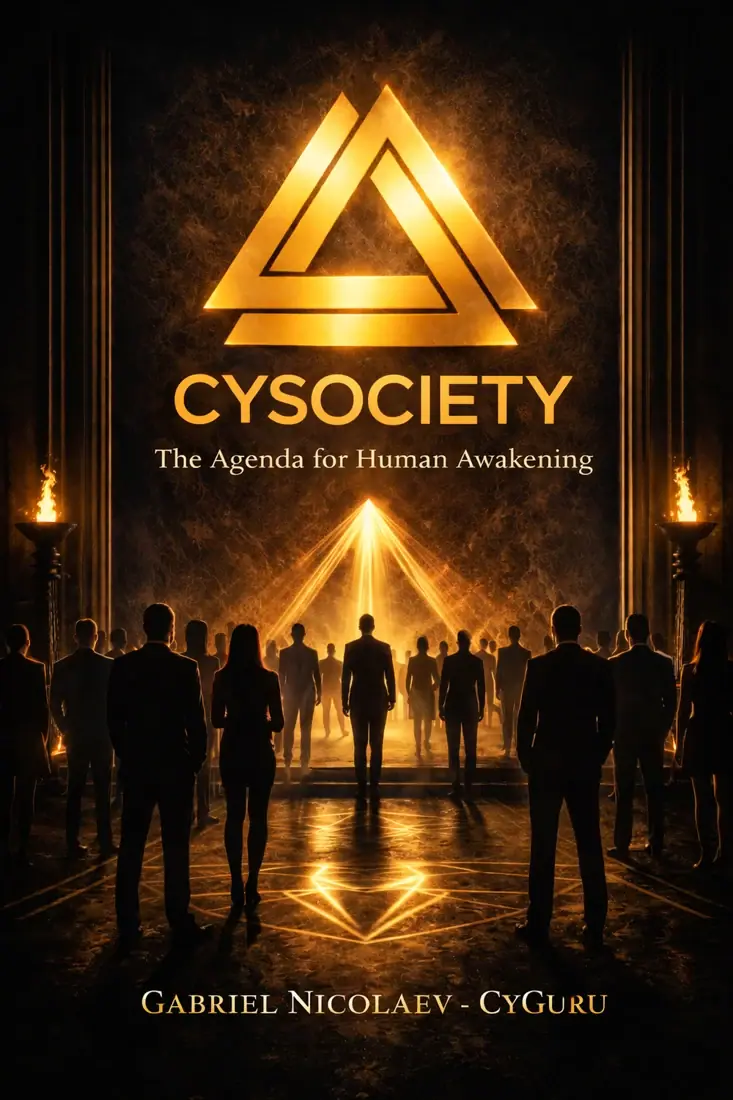
04 / THE FOUNDING BOOK
A Manifesto for a New Civilization
The book explores social conditioning, the structures of modern civilization and the relationship between knowledge, power and responsibility. It introduces the CYSOCIETY philosophy and the 12 Laws of Conscious Civilization.
Discover the book ↗Gabriel Nicolaev — CyGuru · The Human Codes

THE AUTHOR / THE FOUNDING VISION
Author of CySociety and creator of The Human Codes. His CYSOCIETY vision invites readers to understand the systems around them and consider their own capacity to shape what comes next.